


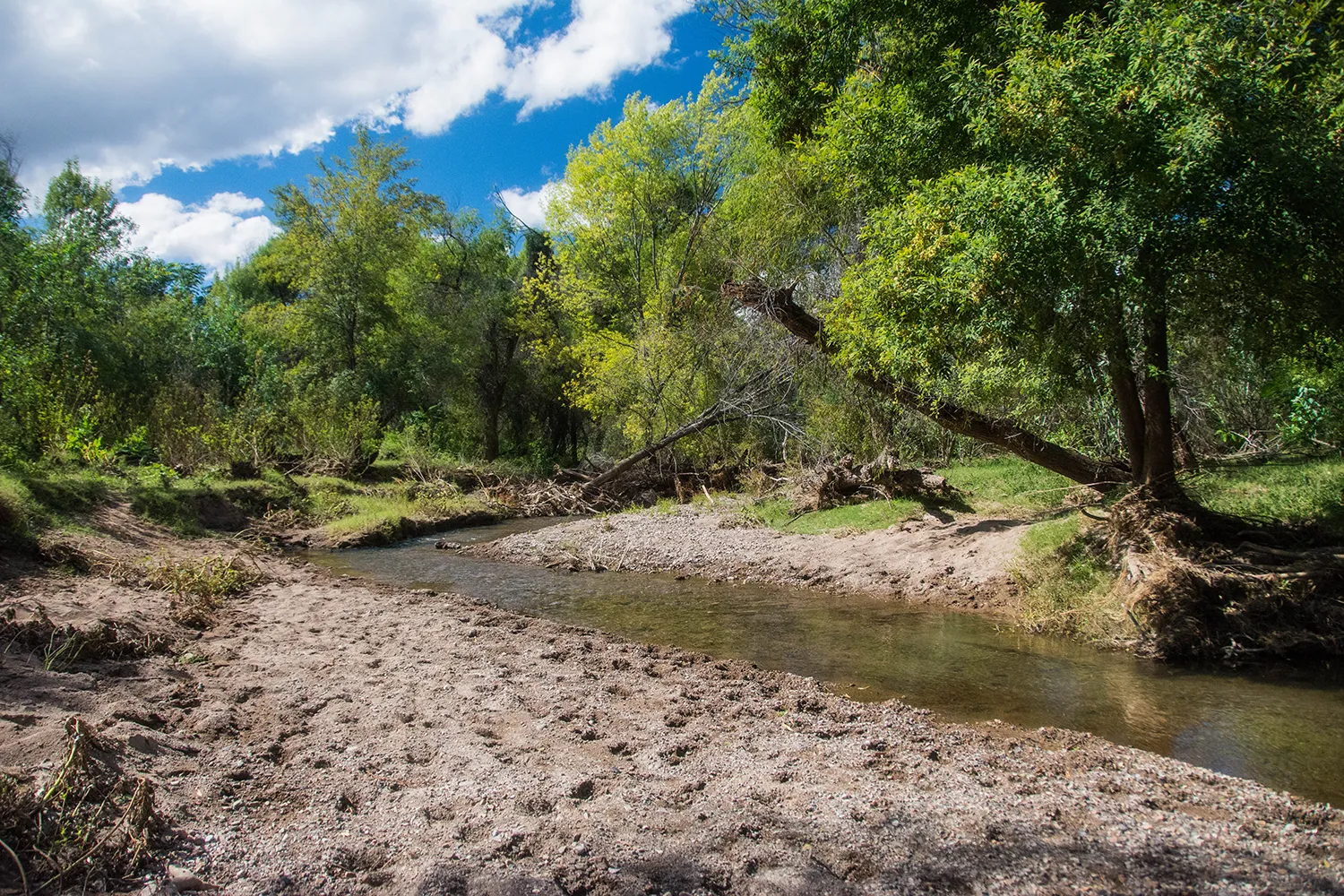
There is a simple truth about water: it does not stop at a property line.
Neither does wildlife. Or wildfire. Or a healthy ecosystem.
Sonoita Creek flows through the landscape of Southern Arizona according to the contours of the land, connecting mountains, grasslands, cottonwood forests, wildlife habitat and the people entrusted with caring for them.
That makes conservation here inherently collaborative.
For Circle Z Ranch and its neighbor, The Nature Conservancy’s Patagonia-Sonoita Creek Preserve, the relationship begins with a shared boundary and a shared waterway. But over the decades, it has grown into something deeper: a partnership built around the idea that protecting this landscape requires thinking beyond individual parcels of land and working together for the future of the entire ecosystem.
“We are fenceline neighbors,” Patagonia-Sonoita Creek Preserve Manager Aaron Mrotek explains. Sonoita Creek flows through The Nature Conservancy preserve and then crosses the property boundary into Circle Z Ranch.
In practical terms, what happens upstream affects what happens downstream.
In philosophical terms, it creates a shared responsibility.
Circle Z and The Nature Conservancy are the primary private landowners along this important stretch of Sonoita Creek, creating an unusual opportunity to approach the waterway as a connected landscape rather than a collection of unrelated properties. Their work together has included invasive-species removal, wildfire mitigation and, most recently, ambitious planning to restore the creek’s natural relationship with its floodplain.
The projects are scientific and complex.
But the idea behind them is wonderfully straightforward:
Take care of the land together.
A Conservation Partnership Built Over Decades
The current chapter of the partnership has become particularly active during the past several years, but the connection between Circle Z and The Nature Conservancy stretches much further back.
The Nash family has supported The Nature Conservancy’s work in the area for decades. According to Mrotek, the family were early supporters of TNC and at one point transferred a 36-acre parcel to the organization. Conservation easements associated with other land further demonstrated the family’s desire to protect open space for generations to come.
That history matters because the Patagonia-Sonoita Creek Preserve itself holds a special place in Arizona conservation history.
The Nature Conservancy established its first Arizona preserve at Patagonia-Sonoita Creek in 1966. Today the preserve protects roughly 870 acres in the Sonoita Creek watershed and some of the richest remaining riparian—or streamside—habitat in the region.
When Mrotek arrived at the preserve in 2022, Circle Z was therefore an obvious neighbor to get to know.
At first, he saw the relationship largely through the lens of conservation.
Circle Z operates a dude ranch, after all. The landscape is fundamental to what guests come to experience. People travel to the ranch to ride beneath broad Arizona skies, cross grasslands and canyons, follow the creek and spend time immersed in a landscape that feels increasingly rare.
Even before he knew how deeply the Nash family cared about biodiversity and ecology, he saw an obvious overlap.
Healthy land was good for the ecosystem.
Healthy land was also good for the ranch.
Then he got to know the family.
“I quickly got to know Diana and her son Richard,” Mrotek recalled. He realized they weren’t simply thinking about the land in terms of operating Circle Z. “They cared about this place on a deeper level, not just a business.”
That discovery became the foundation for what followed.
When Preserving the West Starts With Being a Good Neighbor
There can be a tendency to think about preserving the West in sweeping terms.
Save a mountain range.
Protect a river.
Preserve thousands of acres.
But meaningful conservation also happens fence line by fence line, conversation by conversation.
At Circle Z, the shared boundary with The Nature Conservancy creates opportunities to work on projects neither landowner could approach as effectively alone.
The creek doesn’t become a different ecosystem simply because it passes from one property to another.
So why treat it that way?
That question has become central to the partnership.
“What can we do together to enhance this ecosystem for all of Sonoita Creek?” is how Mrotek describes the thinking behind the relationship.
The answer has evolved over time.
One of the earlier projects involved removing invasive and non-native plant species.
Invasive plants can crowd out native vegetation and simplify ecosystems, reducing the variety of grasses, shrubs and trees that provide food and shelter for wildlife.
For a dude ranch, there is another dimension to the problem.
Guests come to experience the diversity of the landscape itself.
They notice the cottonwoods.
The grasses.
The changing vegetation along the creek.
The dramatic transition from open country into shaded riparian corridors.
Protecting that ecological variety also protects the experience of riding through it.
Want to experience the landscape that generations of Circle Z guests and conservation partners have worked to protect? Book your Circle Z Ranch vacation and explore Southern Arizona from horseback.
Conservation in a Hotter, Drier West
Another issue quickly emerged as an opportunity for collaboration: wildfire.
Across the arid West, warmer and drier conditions can increase the risks associated with severe wildfire. The question for neighboring land managers becomes not simply how to respond to a fire, but how to make the landscape more resilient before one occurs.
Mrotek began discussing that challenge with Circle Z and other regional partners, including the Tucson Bird Alliance.
The goal was to consider conservation at a landscape scale.
Where could vegetation be thinned?
Where would firebreaks be most effective?
How could historical fire patterns inform modern management?
Modeling suggested that some of the most strategically useful locations were on Circle Z property.
According to Mrotek, the Nash family embraced the conversation.
“It was awesome to see how the Nash family was supportive of those ideas,” he said.
Just as importantly, the work did not have to compete with the ranch’s operations.
In some areas, widening corridors to create firebreaks could simultaneously improve routes associated with horseback riding.
“Everything was done side by side with the Nash family,” Mrotek explained. “Projects that are win-win-win for everyone involved.”
That phrase—win-win-win—captures an important lesson about preserving the West.
Effective land stewardship does not always require choosing between people and nature.
Sometimes thoughtful management can improve ecological resilience, help protect homes and businesses and support the ways people responsibly use the landscape.
The Biggest Challenge May Be Hidden in the Creek
Perhaps the most ambitious chapter of the partnership involves a word most guests probably don’t use over breakfast:
Geomorphology.
“It is a fancy word to describe the shape and physical characteristics of a stream channel itself,” Mrotek explained.
Understanding that shape has become essential to understanding what is happening to Sonoita Creek.
The Nature Conservancy commissioned an assessment of the creek and found that parts of its channel have become incised.
In simpler terms, the creek has dug downward.
A healthy floodplain is not supposed to function like a deep drainage ditch.
During natural floods, water should sometimes rise over the stream banks and spread across the surrounding floodplain.
That sounds destructive at first.
In reality, those periodic floods perform essential ecological work.
They slow water.
They deposit sediment.
They provide moisture to floodplain vegetation.
They help create the conditions necessary for trees such as Fremont cottonwoods to reproduce.
When a stream becomes deeply incised, however, floodwaters may remain trapped within the channel instead of spreading across the surrounding land.
The Nature Conservancy’s own current discussion of Sonoita Creek describes this same issue: past land use, climate change and encroachment into the traditional floodplain have contributed to a straighter, more incised stream channel, limiting the overbank flooding that once supported cottonwood regeneration.
And that changes far more than the creek itself.
Restoring the Historic Floodplain
Circle Z and The Nature Conservancy are now looking at conservation not simply as protecting what remains, but as restoring natural processes that have been disrupted.
The objective is to reconnect Sonoita Creek with more of its historic floodplain.
During a flood, creek water carries enormous amounts of sediment—the brown, almost chocolate-colored water familiar to anyone who has seen desert waterways after heavy rain.
Rather than allowing that sediment-rich water to rush rapidly downstream, restoration structures can help slow it.
When water slows, it can drop some of that sediment.
Over time, sediment accumulation can raise portions of the creek system and help water once again reach its floodplain.
The approach is sometimes described as low-tech, process-based restoration. Structures built from natural materials can mimic some of the effects that beavers historically provided in stream ecosystems: slowing water, catching sediment and encouraging the landscape to store moisture for longer periods.
The objective isn’t to engineer the creek into a fixed shape.
It is almost the opposite.
The goal is to give natural processes—water movement, sediment deposition and vegetation growth—the opportunity to function again.
Why a Floodplain Works Like a Sponge
There is another benefit to reconnecting a creek with its floodplain: water storage.
When floodwaters spread onto areas rich in soft, fine sediments, the landscape can act almost like a sponge.
Water soaks into the ground.
That stored water can help recharge shallow groundwater and, over time, slowly return moisture to the creek system.
In a region where permanent surface water is increasingly precious, that function matters tremendously.
“Water in a desert region means life,” Mrotek has explained in The Nature Conservancy’s public discussion of research on Sonoita Creek. TNC describes the riparian corridor as both a biodiversity hotspot and an important wildlife migration corridor in southeastern Arizona and northern Mexico.
The Patagonia-Sonoita Creek Preserve contains some of the richest remaining riparian habitat in the region, including rare Fremont cottonwood-Goodding willow forest. Some Fremont cottonwoods within the preserve are more than a century old and exceed 100 feet in height.
For Circle Z guests, trees like these are part of the beauty of the creek corridor.
For conservationists, they tell a more complicated story.
Saving the Next Generation of Cottonwoods
Many of the large cottonwoods lining Sonoita Creek are old.
That isn’t necessarily the problem.
The problem is what isn’t there – young cottonwoods.
Mrotek explained that natural recruitment—the process by which cottonwood seeds germinate and successfully grow into mature trees—has become limited along sections of the creek.
Planting young trees can help.
But it doesn’t fix the underlying system.
“We can seed and do this other stuff,” he explained, “but it’s a Band-Aid for a systemic issue.”
Healthy cottonwood regeneration depends in part on the natural disturbance created by flooding.
Floods redistribute sediment, create new surfaces for seeds and deliver the moisture young trees need.
If the creek remains confined deep within its channel, those processes cannot occur across the floodplain as they once did.
Restoring geomorphology therefore becomes more than a project about moving water.
It becomes a project about the future forest.
The goal is not simply to preserve today’s majestic cottonwoods.
It is to create the conditions that allow new cottonwoods to germinate, mature and eventually replace them.
That is conservation measured not in seasons, but generations.
Why Riparian Conservation Matters So Much
Riparian habitat occupies a relatively small portion of the Western landscape yet supports an extraordinary concentration of biological activity.
Along Sonoita Creek, water and vegetation create habitat for birds, fish, insects, mammals and native plants that could not thrive in the surrounding dry country in the same way.
The Nature Conservancy describes the Patagonia-Sonoita Creek Preserve as a biodiversity-rich landscape supporting endangered fishes, butterflies, birds, rare plants and remnant wetlands known as cienegas.
TNC is also studying the creek’s water sources and groundwater connections because climate change and groundwater withdrawals continue to create challenges for perennial water in the region.
That helps explain why Mrotek thinks about the Circle Z partnership in such expansive terms.
Work along one stretch of creek can influence a much larger ecological system.
Successful restoration could help native vegetation.
It could support fish and aquatic invertebrates.
It could improve wildlife habitat.
It could help the floodplain hold water longer.
And it could make the creek more resilient decades into the future.
For a family committed to preserving the West, that kind of time horizon matters.
A Dude Ranch With a Different Relationship to the Landscape
Guests experience all of this in a much simpler way.
They get on a horse. They leave the corrals. And they ride.
Across grasslands. Through canyons. Along Sonoita Creek. Beneath cottonwoods and Arizona sycamores.
The scientific language of watershed management may not enter the conversation at all.
Yet that horseback riding experience depends on the very things conservation is working to protect: open space, healthy vegetation, flowing water, wildlife habitat and a landscape that still feels connected.
That is what initially caught Mrotek’s attention when he began building a closer relationship with the ranch.
Circle Z’s business depends, in part, on people falling in love with the landscape.
And perhaps that makes a dude ranch an especially natural partner in conservation.
Guests don’t experience the land in passing. They cross it on horseback.
They feel temperature changes when a trail drops toward the creek. They hear birds in the cottonwoods. They see how radically vegetation changes near water. They travel slowly enough to notice.
Come experience the landscape behind the conservation story. Book a Circle Z Ranch vacation and explore the grasslands, canyons and creek country from horseback.
Conservation Is Also About Relationships
Ask Mrotek about the partnership long enough and the conversation eventually stops sounding like a list of projects.
It becomes a story about people.
When he arrived, he knew that successful conservation would require building relationships not only with the Nash family but also with people throughout the Circle Z operation, including former manager George Lorta and members of the ranch staff.
Those professional relationships gradually became friendships.
Mrotek speaks especially warmly about Richard Nash.
The two walk along Sonoita Creek together and inevitably begin talking about what could happen next.
Even outside of work, conservation ideas have a habit of entering the conversation. “We both get giddy about this stuff,” Mrotek said.
He has watched Richard develop his own environmental knowledge and describes that interest not as something imposed by the ranch business but as a deeply held personal motivation.
For Mrotek, that matters. Technical restoration plans can be designed. Grants can be secured.
Models can identify strategic locations. But lasting land stewardship ultimately depends on people caring enough to keep doing the work.
Preserving the West for the Next 100 Years
Circle Z recently entered its second century.
That makes the long view especially meaningful.
For the first hundred years, generations of guests rode through this landscape, sat beneath its trees, crossed its creeks and watched the evening light move across the surrounding mountains.
What will the landscape look like another hundred years from now?
Will new generations of cottonwoods grow beside Sonoita Creek?
Will perennial water continue supporting wildlife?
Will grasslands remain open?
Will native plants continue thriving?
Will horses still carry guests through this country?
Those questions are much larger than one ranch or one preserve.
But the answers are shaped by decisions people make today.
That is why Circle Z’s relationship with The Nature Conservancy matters.
The Landscape Connects Everything
When Mrotek talks about the Nash family, one thought comes up repeatedly: how unusual it is to find people entrusted with such an extraordinary place who understand the responsibility that comes with it.
“They are responsible for such a cool, unique place in the world,” he said, “and they steer it toward resiliency.”
After working across Arizona, he considers having a neighboring family so invested in the landscape something special.
“I love working with that family and feel privileged to be a part of it.”
That may be the most important lesson in the partnership.
Circle Z and The Nature Conservancy occupy different properties and serve different purposes.
One is a historic dude ranch that invites guests to discover Southern Arizona from horseback.
The other is a conservation organization managing one of Arizona’s most ecologically significant riparian preserves.
But Sonoita Creek connects them.
Preserving the West has never been the work of a single person or organization.
It requires neighbors. Scientists. Landowners. Ranchers. Conservationists.
And people willing to see beyond the fence line.
At Circle Z, that work is happening today along the same creek guests have ridden beside for generations.
And the hope is that by restoring natural processes now, the creek, its cottonwood forest and the remarkable landscape surrounding it will remain resilient for generations still to come.
Come see why this landscape is worth protecting. Book your Circle Z Ranch vacation today and experience the land, horses and Sonoita Creek that inspire a century-long commitment to conservation and preserving the West.